Why Public Speaking Contests Matter for EFL Learners
How speech competitions can transform English learning into real-life communication
For many English as a Foreign Language (EFL) learners, speaking in English can feel intimidating. They may know grammar rules, memorize vocabulary, and do well in written exercises, yet still hesitate when asked to speak in front of others. This is where public speaking contests can make a powerful difference.
Public speaking competitions are much more than school events or extracurricular activities. They are dynamic learning experiences that help students build confidence, improve fluency, and develop essential life skills. For EFL learners in particular, these contests can become a bridge between classroom English and authentic communication.
In this blog post, we will explore the major benefits of public speaking contests for EFL learners and why schools should encourage more students to participate.
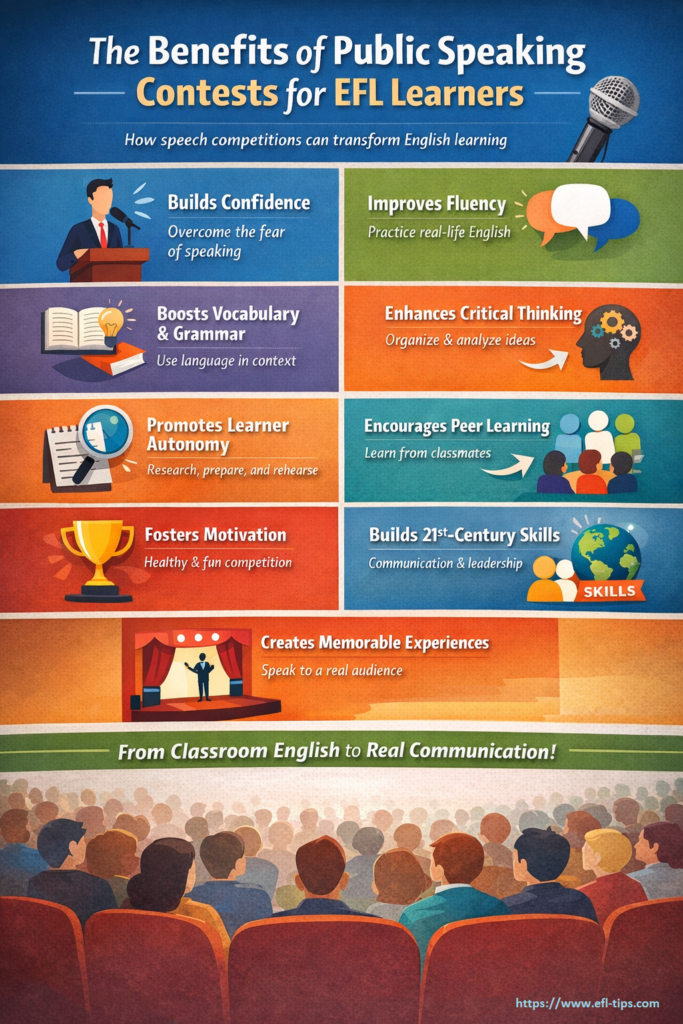
1. They Build Confidence in Speaking English
One of the biggest challenges EFL learners face is fear of speaking. Many students worry about making mistakes, mispronouncing words, or being judged by classmates. Public speaking contests provide a structured and supportive environment where students can gradually overcome these fears.
When learners prepare and deliver a speech, they step outside their comfort zones. Each time they speak before an audience, they become more confident in using English publicly. Over time, this repeated practice reduces anxiety and helps them see that mistakes are part of the learning process.
Confidence gained in a contest often extends beyond the event itself. Students may become more willing to:
- participate in class discussions
- answer teachers’ questions
- give presentations
- express opinions in English
- interact more freely with others
In short, public speaking contests help transform shy learners into confident communicators.
2. They Improve Fluency and Pronunciation
Fluency does not develop through grammar drills alone. Students need meaningful speaking practice, and public speaking contests provide exactly that.
When learners prepare for a speech, they:
- rehearse sentences repeatedly
- practice linking ideas smoothly
- work on rhythm, stress, and intonation
- focus on clear pronunciation
- become more aware of their pace and pauses
This repeated oral practice strengthens automaticity, which is essential for fluency. Instead of translating every sentence in their minds, students begin to produce English more naturally.
Pronunciation also improves because students pay closer attention to how words sound when they know they will be speaking in front of an audience. Teachers can guide them on:
- word stress
- sentence stress
- intonation patterns
- articulation of difficult sounds
- effective pausing for emphasis
As a result, learners become not only more fluent but also more understandable.
3. They Strengthen Vocabulary and Grammar in Context
Public speaking contests push students to use language for a real communicative purpose. Rather than completing isolated grammar exercises, learners must organize ideas and express them clearly to an audience.
To do this successfully, they often need to:
- learn topic-specific vocabulary
- use transition words and linking expressions
- apply grammar accurately in meaningful sentences
- choose persuasive or descriptive language
- vary sentence structures for effect
This kind of language use is far more memorable than mechanical practice. Students remember vocabulary better when they use it to communicate something important to them.
For example, a learner preparing a speech about environmental protection may naturally acquire expressions such as:
- climate change
- renewable energy
- reduce waste
- take responsibility
- future generations
Because these words are tied to a personal message, they are more likely to stick.
4. They Encourage Critical Thinking and Organization of Ideas
Public speaking is not just about speaking well—it is also about thinking clearly.
Before delivering a speech, learners must:
- choose a topic
- define a purpose
- identify key points
- support ideas with examples
- organize an introduction, body, and conclusion
- anticipate audience reactions
This process develops important cognitive skills. Students learn how to build arguments, present evidence, and communicate logically. These are valuable academic skills that support essay writing, debates, and project presentations as well.
For EFL learners, this is especially useful because it combines language development with higher-order thinking. Students are not simply learning English words; they are learning how to use English to analyze, persuade, inspire, and inform.
5. They Promote Learner Autonomy
Preparing for a public speaking contest often requires students to take ownership of their learning. Unlike routine classroom tasks, a speech contest demands personal effort beyond the textbook.
Learners may need to:
- research their topic
- draft and revise their speech
- practice independently at home
- record themselves
- seek feedback from teachers or peers
- improve weak areas through self-correction
This encourages autonomous learning, which is a key goal in modern language education. Students begin to realize that progress in English is not limited to what happens in the classroom. They become active participants in their own learning journey.
When students discover that hard work leads to visible improvement, their motivation often increases significantly.
6. They Develop Listening and Peer Learning Skills
Even students who are not speaking in the contest benefit from attending and listening. Public speaking events create rich opportunities for peer learning.
By watching others, learners can notice:
- effective speech openings
- strong body language
- useful expressions and vocabulary
- pronunciation models
- persuasive techniques
- ways to engage an audience
They can also reflect on what makes a speech successful. This helps them become more analytical listeners and more thoughtful speakers.
In this way, a public speaking contest is not only a competition—it is a collaborative learning experience for the whole class or school community.
7. They Foster Motivation and Healthy Competition
EFL learners often need a strong reason to go beyond minimum classroom participation. Public speaking contests provide a clear goal, a sense of purpose, and an exciting challenge.
Healthy competition can motivate students to:
- prepare more seriously
- practice more frequently
- improve the quality of their language
- pay attention to delivery and accuracy
- strive for personal excellence
For many learners, the idea of representing their class or school creates pride and commitment. The contest becomes a meaningful event rather than just another assignment.
It is important, however, that teachers frame these competitions positively. The real goal should not only be winning, but growth, courage, and communication.
8. They Build Essential 21st-Century Skills
Public speaking contests help EFL learners develop skills that go far beyond language learning. In today’s world, students need to communicate clearly, think critically, and present ideas confidently.
Through speech contests, learners develop:
- communication skills
- leadership potential
- self-discipline
- creativity
- problem-solving skills
- emotional resilience
- audience awareness
- persuasive speaking skills
These competencies are valuable in academic settings, future careers, and everyday life. Whether students become teachers, entrepreneurs, engineers, or public servants, the ability to speak effectively in public will always be an advantage.
9. They Create Memorable and Authentic Learning Experiences
Students often forget routine lessons, but they rarely forget the day they stood on a stage and delivered a speech in English.
Public speaking contests are memorable because they involve:
- emotion
- challenge
- achievement
- real audiences
- authentic communication
- personal expression
This makes learning more meaningful. Instead of seeing English as just a school subject, learners begin to experience it as a tool for sharing ideas and making an impact.
These moments can shape students’ attitudes toward English for years to come.
10. They Can Be Especially Powerful in the EFL Classroom
In many EFL contexts, students have limited opportunities to use English outside school. Public speaking contests create a rare but valuable space where English becomes active, visible, and purposeful.
For teachers, they are an excellent way to:
- integrate speaking with writing and listening
- assess communication holistically
- encourage project-based learning
- celebrate student achievement
- create a positive English-speaking culture in school
For learners, they show that English is not just for passing exams—it is for being heard
Tips for Teachers: How to Make Public Speaking Contests More Inclusive
To ensure that public speaking contests benefit all EFL learners, teachers should make them supportive rather than intimidating. Here are a few practical tips:
1. Focus on progress, not perfection
Encourage students to view mistakes as part of learning.
2. Offer scaffolding
Provide models, useful expressions, outlines, and rehearsal support.
3. Use clear rubrics
Assess content, organization, language use, pronunciation, body language, and audience engagement fairly.
4. Create different levels
Allow beginner, intermediate, and advanced learners to participate in age-appropriate or proficiency-based categories.
5. Celebrate all participants
Certificates, positive feedback, and recognition matter—not only prizes.
6. Encourage peer feedback
Train students to give constructive and respectful comments.
7. Start small
Begin with classroom mini-speeches before moving to school-wide competitions.
In a nutshell
Public speaking contests are far more than competitions. For EFL learners, they are opportunities to grow in confidence, fluency, pronunciation, critical thinking, and personal expression. They transform English from a subject studied in notebooks into a language used with purpose and power.
When learners stand before an audience and speak in English, they are doing something extraordinary: they are claiming their voice in another language.
That is why public speaking contests deserve a meaningful place in EFL education.
If we want EFL learners to become confident speakers, we must give them real opportunities to speak. Public speaking contests provide exactly that. They challenge students, motivate them, and help them discover that they can do more in English than they ever imagined.
In the end, the greatest reward is not the trophy—it is the confidence to say, “I have something to say, and I can say it in English.”