A Teacher’s Guide to Effective Test Correction Sessions
Test correction sessions are an essential part of the teaching and learning process. They provide students with the opportunity to understand their mistakes, improve their language skills, and reflect on their learning strategies. However, correction sessions can easily become boring or stressful if they are not well managed. Effective teachers transform these sessions into interactive learning experiences that encourage participation, reflection, and improvement.
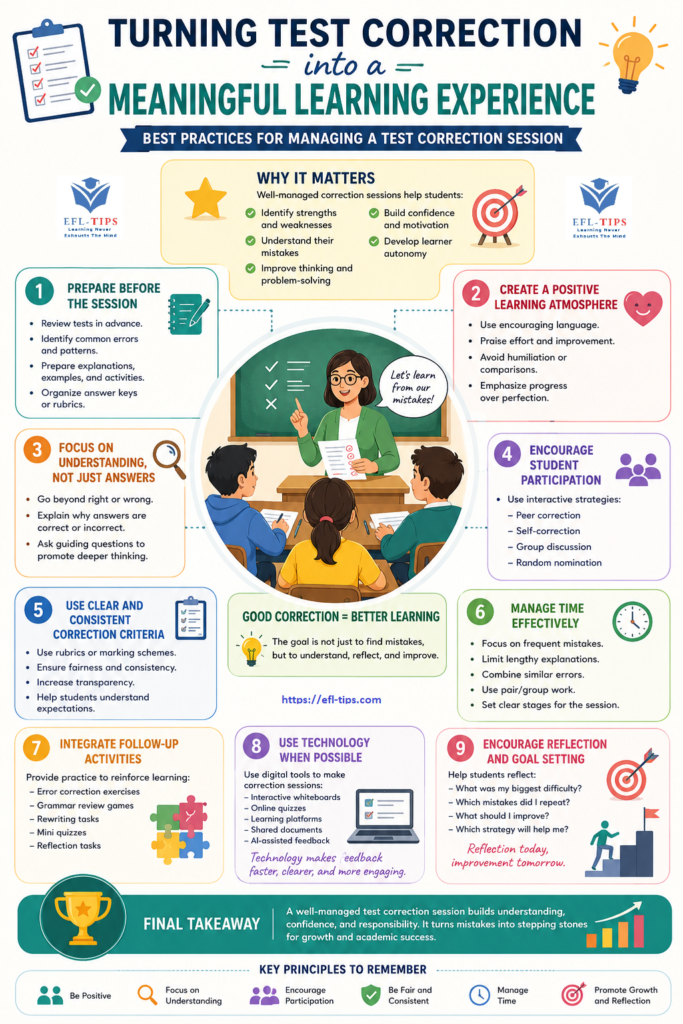
1. Why Test Correction Sessions Matter
A correction session is not simply a moment to announce marks or provide correct answers. It is a valuable teaching opportunity where students can analyze their performance and develop a better understanding of the subject matter.
Well-managed correction sessions help students:
- Identify their strengths and weaknesses
- Understand the reasons behind their mistakes
- Improve problem-solving and critical thinking skills
- Build confidence and motivation
- Develop learner autonomy
For teachers, correction sessions provide insight into students’ difficulties and help identify areas that require reteaching or additional practice.
2. Prepare Before the Session
Successful correction sessions begin with careful preparation. Teachers should review students’ tests in advance and identify the most common errors. Instead of correcting every small detail individually during class time, focus on patterns of mistakes that affect many students.
Preparation may include:
- Selecting examples of common mistakes
- Preparing explanations or mini-reviews
- Designing short follow-up activities
- Organizing answer keys or correction rubrics
A structured plan helps the session remain focused and efficient.
3. Create a Positive Learning Atmosphere
Students may feel anxious or disappointed when receiving corrected tests. Teachers should therefore create a supportive environment where mistakes are viewed as part of learning rather than failure.
Positive practices include:
- Using encouraging language
- Praising effort and improvement
- Avoiding humiliation or negative comparisons
- Emphasizing progress over perfection
When students feel safe and respected, they are more willing to participate and learn from their errors.
4. Focus on Understanding, Not Just Answers
One common mistake in correction sessions is giving students the correct answers without explanation. Effective correction goes beyond “right” and “wrong.” Students need to understand why an answer is correct and why another answer is not.
Teachers can encourage deeper understanding by asking questions such as:
- Why is this answer incorrect?
- Which grammar rule applies here?
- How could this sentence be improved?
- What clue in the text helped you find the answer?
This approach develops analytical thinking and reinforces learning.
5. Encourage Student Participation
Correction sessions should not be teacher-centered lectures. Students learn more effectively when they actively participate in the correction process.
Interactive strategies may include:
a. Peer Correction
Students exchange papers and correct each other’s work under teacher supervision. This encourages collaboration and critical thinking.
b. Self-Correction
Teachers provide hints or correction codes instead of direct answers, allowing students to identify and fix their own mistakes.
c. Group Discussion
Students work in groups to analyze difficult questions and explain answers together.
d. Random Nomination
Instead of relying only on volunteers, teachers can randomly select students to answer questions. This keeps the entire class engaged and attentive.
6. Use Clear and Consistent Correction Criteria
Fairness is essential during test correction. Students should clearly understand how marks are awarded and why points were deducted.
Using rubrics or marking schemes helps:
- Ensure consistency
- Reduce subjectivity
- Increase transparency
- Help students understand expectations
Clear criteria are especially important for writing and speaking tasks.
7. Manage Time Effectively
Correction sessions can easily become too long and repetitive. Teachers should prioritize important learning points rather than correcting every single item in detail.
Useful time-management techniques include:
- Focusing on frequent mistakes
- Limiting lengthy explanations
- Combining similar errors
- Using pair or group work to save time
- Setting clear stages for the session
A dynamic pace keeps students focused and motivated.
8. Integrate Follow-Up Activities
Correction should lead to improvement. After reviewing mistakes, teachers should provide opportunities for students to practice and apply what they learned.
Examples of follow-up activities include:
- Error correction exercises
- Grammar review games
- Rewriting incorrect sentences
- Mini quizzes
- Reflection tasks
These activities reinforce learning and reduce the likelihood of repeating mistakes.
9. Use Technology When Possible
Digital tools can make correction sessions more interactive and efficient. Teachers may use:
- Interactive whiteboards
- Online quizzes
- Learning platforms
- Shared documents
- AI-assisted feedback tools
Technology can also help visualize common mistakes and provide immediate feedback.
10. Encourage Reflection and Goal Setting
At the end of the session, students should reflect on their performance and identify areas for improvement. Reflection encourages responsibility and independent learning.
Teachers can ask students to answer questions such as:
- What was my biggest difficulty?
- Which mistakes did I repeat?
- What should I improve before the next test?
- Which learning strategy can help me improve?
Goal setting transforms correction into a continuous learning process.
Conclusion
Managing a test correction session effectively requires preparation, organization, and a learner-centered approach. The goal is not only to correct mistakes but also to help students understand, reflect, and improve.
By creating a positive atmosphere, encouraging participation, providing meaningful feedback, and integrating follow-up activities, teachers can turn correction sessions into powerful learning experiences that promote growth, confidence, and academic success.