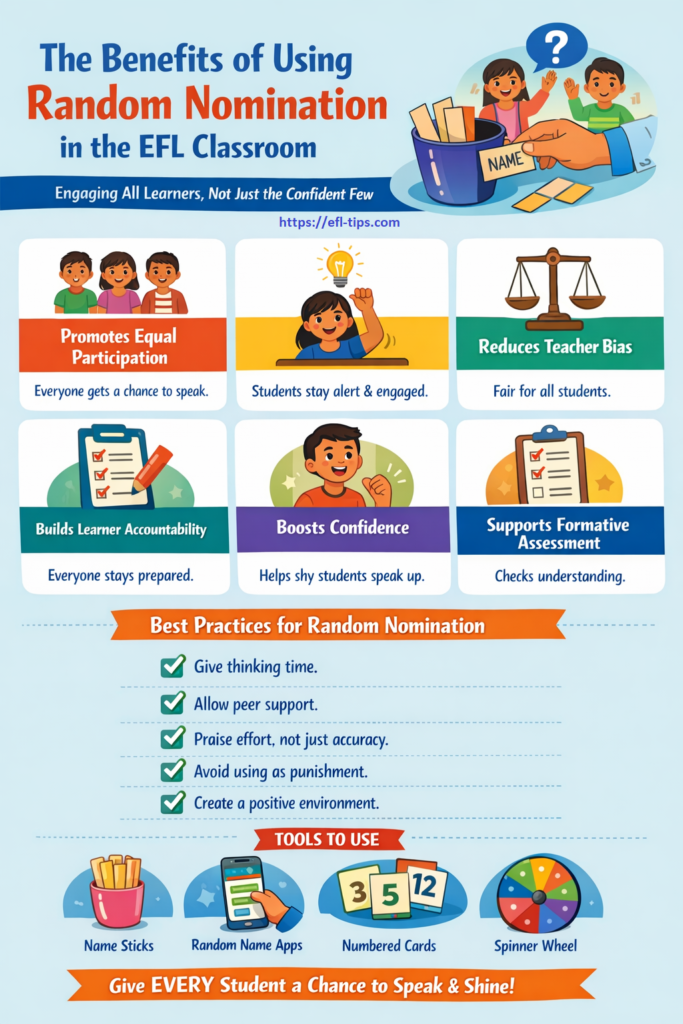
The Benefits of Using Random Nomination in the EFL Classroom
Engaging All Learners, Not Just the Confident Few
One common challenge in EFL classrooms is uneven participation. While some students eagerly volunteer answers, many others—often shy, anxious, or less confident in English—remain silent. Over time, this creates gaps in learning and engagement.
Random nomination, sometimes called no-hands-up questioning, is a simple but powerful strategy that helps teachers involve all learners, improve attention, and promote equity in classroom interaction.
What Is Random Nomination?
Random nomination is a questioning technique where the teacher selects students at random to answer questions, rather than relying on volunteers. This can be done using:
- Name cards or sticks
- Numbered seating
- Digital random name generators
- Spinner wheels
The goal is not to catch students out but to ensure everyone thinks, prepares, and participates.
1. Promotes Equal Participation
Random nomination gives every student a fair chance to speak, regardless of confidence level or language proficiency.
In EFL contexts, this is especially important because:
- Speaking opportunities are limited
- Language development requires frequent practice
- Silent students risk falling behind
Research shows that equitable questioning strategies increase student involvement and reduce participation gaps.
2. Improves Attention and Engagement
When students know they might be called on at any time, they are more likely to:
- Listen actively
- Process questions
- Prepare answers mentally
This shifts students from passive listeners to active thinkers, which is essential for language acquisition.
3. Reduces Teacher Bias
Teachers often (unintentionally) call on:
- High-achieving students
- Confident speakers
- Students seated at the front
Random nomination removes this bias and creates a transparent and fair participation system, which students quickly recognize and respect.
4. Builds Learner Accountability
Random nomination fosters a culture where:
- Everyone is expected to think
- Participation is a shared responsibility
- Preparation becomes a habit
Students learn that engagement is not optional, which leads to better classroom discipline and focus.
5. Gradually Builds Confidence
Although some learners may feel anxious at first, repeated exposure in a supportive environment helps them:
- Overcome fear of speaking
- Accept mistakes as part of learning
- Gain confidence over time
When teachers praise effort rather than accuracy, random nomination becomes empowering rather than threatening.
6. Supports Formative Assessment
Random nomination allows teachers to:
- Check understanding across the whole class
- Identify misconceptions early
- Adjust instruction immediately
This aligns strongly with assessment for learning principles.
Best Practices for Using Random Nomination Effectively
To avoid anxiety and maximize benefits, teachers should:
✔ Give thinking time before nominating
✔ Allow pair or group discussion first
✔ Accept partial or supported answers
✔ Praise effort and risk-taking, not just correct answers
✔ Never use random nomination as punishment
A safe, positive classroom climate is essential.
Conclusion
Random nomination is a low-cost, high-impact strategy that promotes fairness, engagement, accountability, and confidence in the EFL classroom. When used thoughtfully, it ensures that every learner thinks, speaks, and participates—not just the confident few.
In effective EFL teaching, participation should not depend on who raises their hand fastest. It should be shared, structured, and inclusive.